In 2026, Extended Producer Responsibility (EPR) for packaging in the United States has reached a critical inflection point. What was once a developing regulatory concept has become a complex, multi-state compliance reality, with reporting obligations, fees, and enforcement now taking shape across several jurisdictions.
For brands and packaging importers operating internationally, this shift brings both opportunity and challenge. The U.S. model differs significantly from the more established systems in the UK and Europe, creating new layers of operational complexity, data requirements, and cost uncertainty.
Turning Point: Why 2026 Matters
Extended Producer Responsibility (EPR) for packaging in the United States has moved decisively from policy discussion to operational reality.
In 2025, many programmes were still being designed. In 2026, the shift is clear:
- Registration, reporting, and fee payments are now active requirements
- Non-compliance carries financial and market-access risks
- Internal data gaps are becoming costly operational issues
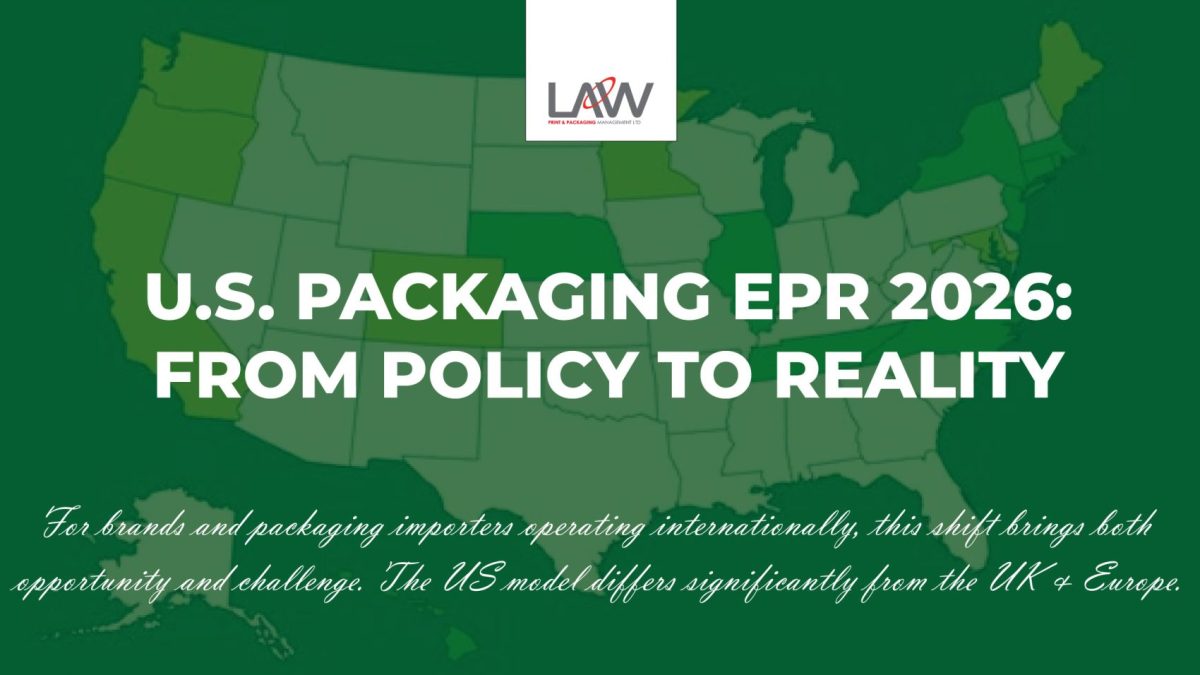
Seven U.S. states now have packaging EPR laws in place — including California, Colorado, Oregon, Maine, Minnesota, Maryland, and Washington — each at different stages of rollout.
This fragmented, state-led approach defines the U.S. market in 2026.
Key US EPR Milestone Dates for 2026
While timelines vary by state, several critical deadlines shape the 2026 compliance calendar:
1. Oregon (first operational programme)
- Spring 2026: Reporting of 2025 packaging data
- May 2026: Ecomodulation incentives and fee adjustments
- Ongoing: Fee reductions tied to packaging design performance
Oregon remains the benchmark, having launched its programme in July 2025.
2. Maine (programme mobilisation phase)
- April 2026: Selection of stewardship organisation
- May 2026: Producer registration + first data reporting
- September 2026: Initial fee payments
3. Colorado (fees go live)
- January 1, 2026: Producer fee obligations begin
4. Washington (system build phase)
- January 2026: PRO appointment
- July 2026: Producer registration begins
5. California (largest and most influential programme)
- Early 2026: Finalisation of regulations and producer responsibility framework (SB 54)
- Mid–2026: Producer registration and initial data submission expected to begin
- October 2026: Submission of the Producer Responsibility Organisation (PRO) plan to CalRecycle
California is the most closely watched programme due to its scale and influence, with requirements expected to set the tone for other U.S. states.
| Factor | Why California Matters |
|---|---|
| Scale | Covers one of the largest consumer markets in the U.S., impacting high volumes of packaging |
| Ambition | Includes recyclability targets, plastic reduction goals, and eco-modulated fees |
| Influence | Likely to shape future EPR legislation across other U.S. states |
| Complexity | Requires detailed data reporting, evolving guidance, and robust compliance systems |
For many organisations, “comply with California first” is becoming the most practical strategy for managing U.S. EPR requirements.
6. Broader trend across states
- 2026 marks the transition from reporting to financial responsibility
- Multiple states are moving from planning to enforcement simultaneously
A Defining Feature: the U.S. “Patchwork” Model
Unlike Europe, the U.S. does not have a federal EPR framework.
Instead, companies face:
- State-by-state legislation
- Different scopes, materials, and definitions
- Multiple reporting formats and deadlines
This creates what many experts describe as a “patchwork system” — one of the biggest compliance challenges for global brands.
How the US compares to the UK and Europe
1. Regulatory structure
| Region | Structure | Complexity |
|---|---|---|
| United States | State-led (no federal system) | High fragmentation |
| United Kingdom | National scheme (reformed EPR from 2024–2026) | Moderate |
| European Union | Harmonised directives + national implementation | Structured but mature |
Europe has over 60 countries globally operating EPR systems, many with long-established frameworks.
2. Maturity of systems
- Europe:
- Established for decades (e.g. Germany, France)
- Mature recycling infrastructure
- Advanced eco-modulation (fees linked to recyclability)
- UK:
- Transitioning to full EPR (fees based on recyclability from 2025–2026)
- Centralised reporting via government scheme
- U.S.:
- Early-stage but accelerating rapidly
- Infrastructure funding is a key objective
- Eco-modulation still developing
3. Financial responsibility
Across all regions, the principle is the same:
Producers must fund the collection, recycling, and end-of-life management of packaging
However:
- Europe/UK: costs are predictable and structured
- U.S.: costs are uncertain and variable by state, with evolving fee models
4. Operational burden
| Factor | U.S. | UK / EU |
|---|---|---|
| Data reporting | Multiple formats | Centralised (UK) / harmonised (EU) |
| PRO engagement | Multiple or state-specific | Typically one per country |
| Compliance strategy | Decentralised | More standardised |
Real Challenges for Brands and Importers
1. Data complexity is now a financial risk
EPR is fundamentally a data-driven regulation:
- Packaging weight
- Material type
- Market placement by geography
In 2026, poor data quality directly impacts fees and compliance exposure.
2. Internal ownership confusion
A recurring issue across organisations:
- Who owns EPR — sustainability, finance, procurement, or compliance?
Without clear ownership, companies struggle to:
- Register on time
- Submit accurate reports
- Budget for fees
3. Multi-state compliance burden
Selling into multiple U.S. states means:
- Different rules per jurisdiction
- Multiple registrations
- Parallel reporting cycles
This is significantly more complex than operating in a single EU market.
4. Cost uncertainty and budgeting pressure
EPR introduces new cost lines:
- Producer Responsibility Organisation (PRO) fees
- Administrative and reporting costs
- Packaging redesign investments
These costs vary widely and are still evolving in the U.S.
5. Packaging design implications
EPR is not just compliance — it is driving design change:
- Recyclability affects fees
- Material choices impact cost exposure
- Eco-modulation incentives reward better design
What Successful Companies Are Doing in 2026
Across the market, leading brands are taking a structured approach:
- Centralising packaging data globally
- Mapping obligations by state and country
- Engaging early with PROs
- Integrating EPR into product design decisions
- Forecasting EPR as a long-term cost driver
From Compliance to Strategy
EPR in the U.S. is no longer a future risk — it is a current operational reality.
2026 represents a shift:
- From legislation → execution
- From awareness → accountability
- From cost centre → design driver
For brands and importers, the opportunity is clear:
Those who treat EPR as a strategic function, not just a compliance task, will be best positioned to manage costs, reduce risk, and compete in a rapidly evolving packaging landscape.
At Law Print, we support organisations in bringing structure to this complexity — helping translate regulatory requirements into clear, actionable packaging data and compliance processes. From material specifications to print and packaging insights, having the right information at the right time is critical to staying compliant and controlling costs.
Equally, navigating the operational and financial aspects of U.S. EPR often requires specialist, in-market expertise. This is where collaboration becomes key. As part of the Pet Sustainability Coalition (PSC) membership network, partners such as rePurpose play an important role in helping brands understand and manage their EPR obligations in the U.S., offering practical support in a rapidly changing regulatory environment.
Contact us on +44 (0) 161 440 7302. Alternatively, follow this link to complete our contact form.