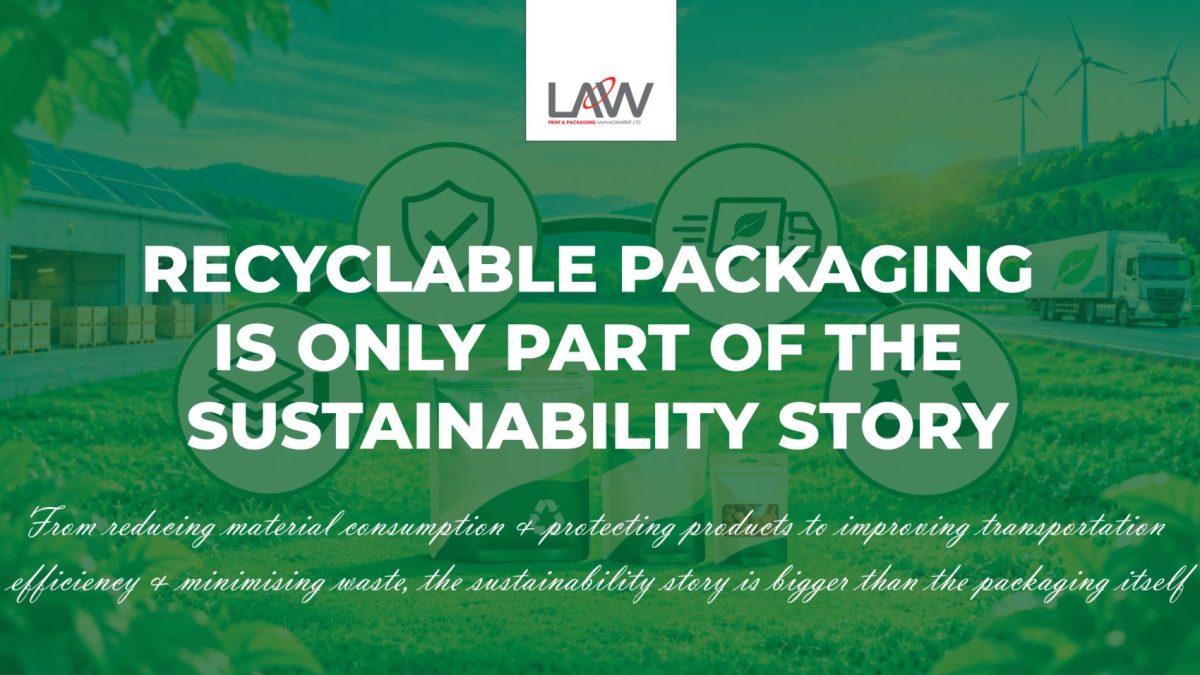
Recyclability has become one of the biggest talking points in packaging, but is it enough to make a pack truly sustainable?
As brands face increasing pressure to reduce their environmental impact, the conversation needs to go beyond simply choosing recyclable materials.
From reducing material consumption and protecting products to improving transportation efficiency and minimising waste, the real sustainability story is much bigger than the packaging itself.
Sustainability Is About the Bigger Picture
For many businesses, moving towards recyclable packaging has become an important priority.
And rightly so. Developing packaging structures that can be collected, sorted and recycled through appropriate waste management systems is an essential part of supporting a more circular economy.
But recyclability is only one part of the equation.
A pack may be technically recyclable, yet use more material than necessary. Another might be lightweight but fail to protect its contents adequately. A different format could reduce material consumption while creating additional challenges during transportation or filling.
The reality is that there is no single characteristic that automatically makes packaging sustainable.
Instead, businesses need to consider how materials, design, manufacturing, product protection, logistics and end-of-life management work together.
1. Lightweighting: Less Can Sometimes Mean More
One of the most effective ways to reduce packaging material consumption is to use less of it in the first place.
Lightweighting involves reviewing packaging specifications to identify opportunities to reduce material weight without compromising essential performance.
For flexible packaging, this might mean optimising film thickness, reviewing laminate structures or adjusting pack dimensions.
For rigid packaging, it could involve reducing container weight or reconsidering the amount of material required to achieve the necessary strength and functionality.
The potential benefits include:
- Reduced material consumption: using fewer raw materials per pack
- Lower packaging weight: potentially reducing transportation loads
- Improved material efficiency: optimising specifications around actual product requirements
- Commercial benefits: opportunities to reduce material-related costs where performance and manufacturing efficiency are maintained
However, lightweighting should never become a race to use the thinnest possible material.
A reduction in thickness that leads to more damaged packs, sealing problems or product waste could undermine the intended environmental benefits.
The goal isn’t simply to use less packaging. It’s to use the right amount of packaging.
2. Product Protection: The Sustainability Factor We Sometimes Forget
Packaging has a fundamental purpose: protecting the product inside.
This is particularly important in food and pet food applications, where moisture, oxygen, light and other external factors can affect product quality, freshness and shelf life.
If packaging fails to provide adequate protection, the consequences can extend far beyond the pack itself.
Spoiled food, damaged products, rejected deliveries and unnecessary returns all create waste and consume additional resources.
In some applications, the environmental impact associated with producing the contents may be considerably greater than that of the packaging used to protect them.
That means a material change which reduces packaging impact but significantly increases product waste may not deliver the overall sustainability improvement expected.
Barrier performance, seal integrity, puncture resistance and durability therefore remain essential considerations.
At Law Print, our experience with high-barrier flexible packaging, including recyclable mono-material structures, helps customers evaluate material options that balance environmental objectives with product protection.
Because packaging that protects its contents effectively is already performing an important sustainability function.
3. Recyclability: Designing for Real-World Recovery
Recyclable packaging remains an important part of the sustainability conversation, but it is essential to distinguish between a material being technically recyclable and it actually being recycled.
The ability to recycle a pack depends on several factors, including its material composition, design, collection infrastructure, sorting capabilities and the availability of suitable recycling processes.
These conditions can vary significantly between countries and even between local waste collection systems.
For example, a mono-material PE pouch may be designed for recycling through suitable flexible plastic recycling streams, but that doesn’t necessarily mean it will be accepted through every household collection system.
Similarly, packaging features such as labels, closures, coatings and barrier layers may influence compatibility with recycling processes.
This makes responsible material selection and clear communication particularly important.
Rather than relying on broad sustainability claims, brands should understand the recycling options available in their target markets and communicate the relevant information accurately.
Designing packaging for recyclability is an important step. Ensuring it has a realistic route to recovery is equally important.
4. Packaging Waste Starts Long Before the Consumer
When discussing packaging waste, attention often focuses on what happens after the consumer has finished using the product.
But waste can occur at every stage of the packaging lifecycle:
- During manufacturing: material offcuts, production start-up waste and rejected packs can contribute to unnecessary resource consumption
- At the filling stage: poorly performing packaging may result in damaged packs, sealing failures or interrupted production
- During storage and transportation: inadequate pack strength or unsuitable palletisation can lead to further losses
- Even inaccurate forecasting can create waste if obsolete printed packaging is left unused following a product redesign or specification change
Reducing these sources of waste requires a coordinated approach involving packaging suppliers, manufacturers, brand owners and packing operations.
Opportunities might include improving material specifications, refining production processes, reviewing pack dimensions, planning artwork changes more carefully and aligning order quantities with realistic demand.
Sometimes, better planning and improved packaging performance can deliver sustainability benefits without changing the material at all.
5. Transportation Efficiency: Making Every Journey Count
Packaging doesn’t exist in isolation. It forms part of a wider supply chain.
The weight, dimensions and construction of a pack can influence how efficiently products are stored, transported and distributed.
Flexible packaging can offer advantages in certain applications because unfilled pouches and films are generally compact and lightweight compared with many rigid alternatives.
However, transportation efficiency also depends on the finished pack, product density, pallet configuration, shipping distances and distribution requirements.
A well-designed pack can help make better use of available space, reduce unnecessary empty volume and improve handling efficiency.
Similarly, sourcing decisions can influence transport requirements.
Manufacturing closer to the point of use may reduce transportation distances, while larger, efficiently planned production runs from further afield may offer other operational and commercial advantages.
At Law Print, our global manufacturing network across Asia and Europe allows us to consider different sourcing options according to customer requirements.
The important point is that transportation efficiency should be assessed as part of the complete supply chain, rather than assuming that one manufacturing location or packaging format is automatically the most sustainable choice.
6. Responsible Material Selection: Finding the Right Balance
Choosing a packaging material involves balancing several requirements that don’t always point towards the same solution.
A material may offer excellent barrier performance but present recycling challenges.
Another may be easier to recycle through an established collection stream but require changes to pack construction or filling conditions.
A lighter structure may reduce material consumption but need further testing to confirm its durability.
And while recycled content can be an important consideration, its suitability depends on factors such as material availability, technical performance, food-contact requirements and applicable regulations.
This is why material selection should begin with a clear understanding of the product and its intended application.
Key considerations include:
- Product protection and required shelf life
- Material weight and resource efficiency
- Recyclability in the intended market
- Suitability of recycled content where appropriate
- Filling-line compatibility and production performance
- Consumer functionality and convenience
- Transportation and storage requirements
- Relevant packaging legislation and sustainability objectives
No single material will necessarily perform best against every criterion.
The aim is to identify the most appropriate solution based on the full packaging requirement, supported by technical assessment and testing where necessary.
7. Making Better Decisions Through Collaboration
As sustainability requirements become more complex, collaboration between brands and packaging partners is increasingly valuable.
A packaging specification may involve decisions about materials, barrier properties, printing, pack construction, production processes and end-of-life considerations.
Each decision can influence another.
For example, changing to a recyclable mono-material structure may require adjustments to sealing conditions, pack dimensions or filling-line settings.
Reducing film thickness could affect pack stiffness or handling performance.
Introducing a new format may create opportunities to improve material efficiency but require changes to the packing operation.
Addressing these considerations early in the development process can help businesses identify practical improvements and avoid unnecessary compromises.
At Law Print, we work closely with customers and manufacturing partners to assess packaging requirements from both a technical and commercial perspective.
Our expertise in flexible packaging, recyclable structures, material development and printing, combined with access to the wider SCGP Flexible + Rigid packaging portfolio, allows us to explore a broader range of potential solutions.
The objective isn’t to promote one material or format as the answer to every sustainability challenge.
It’s to help customers make informed decisions based on their products, operations and long-term objectives.
8. Moving Beyond Claims Towards Measurable Progress
As environmental expectations and packaging regulations continue to evolve, businesses are increasingly being challenged to demonstrate the basis for their sustainability claims.
Terms such as eco-friendly, green or sustainable can be misleading when used without clear supporting evidence.
A more meaningful approach is to focus on specific, measurable improvements.
For example, a business might aim to reduce packaging material weight by a defined percentage, increase the proportion of its portfolio designed for recycling, reduce manufacturing waste or improve transportation efficiency.
These objectives can then be assessed against appropriate technical data and, where relevant, lifecycle assessments.
Importantly, improvements in one area should be considered alongside any potential impacts elsewhere.
A reduction in material weight, for instance, is a measurable achievement, but it shouldn’t automatically be presented as an overall reduction in environmental impact without considering other relevant factors.
Credible sustainability progress is built on evidence, transparency and continuous improvement – not simply attractive claims.
Conclusion: Better Packaging Means Looking Beyond Recyclability
Recyclability is an important part of creating a more circular packaging economy, but it should never be the only measure of environmental performance.
Material efficiency, product protection, manufacturing waste, transportation, responsible sourcing and end-of-life management all have a role to play.
For brands, the challenge is to look beyond individual packaging characteristics and consider how the entire packaging solution performs.
Sometimes the best improvement will be a recyclable material conversion. Sometimes it will be a lighter specification, a more efficient format, better product protection or a smarter approach to supply planning.
And often, the greatest progress comes from combining several improvements rather than focusing on just one.
At Law Print, we believe that responsible packaging development starts with understanding the complete picture.
With our technical expertise, experience in recyclable flexible packaging, global manufacturing partnerships and access to the wider SCGP Flexible + Rigid portfolio, we can help customers explore solutions that balance product performance, commercial requirements and environmental objectives.
Because truly responsible packaging isn’t just about what happens to the pack at the end of its life. It’s about making better decisions throughout its entire journey.
Looking to review your packaging materials, reduce unnecessary waste or explore more recyclable solutions? Talk to the Law Print team about how our packaging expertise can help you identify practical opportunities for improvement.
Contact us on +44 (0) 161 440 7302 or sales@lawprintpack.co.uk. Alternatively, follow this link to complete our contact form.